

Author
Managing Climate Change in Wilderness: Scenario-Based Approaches for an Uncertain Future
Date
How do you manage for change in places meant to remain wild? That is the central question facing land managers across the American West as climate change accelerates ecological transformation, even in federally protected wilderness areas. A new NC CASC-supported case study, “RAD Decisions in Rad Landscapes: Black Ridge Canyons Wilderness”, tackles this challenge head-on, offering a practical, transparent framework for decision-making under uncertainty.
Advised by NC CASC climate scientist Imtiaz Rangwala and ecologist Kyra Clark-Wolf, who collaborated with scientists from the Aldo Leopold Wilderness Research Institute (ALWRI) and land managers from the Bureau of Land Management (BLM), the project applies the Resist-Accept-Direct (RAD) framework to one of the most climate‑vulnerable wilderness areas in the Colorado Plateau.
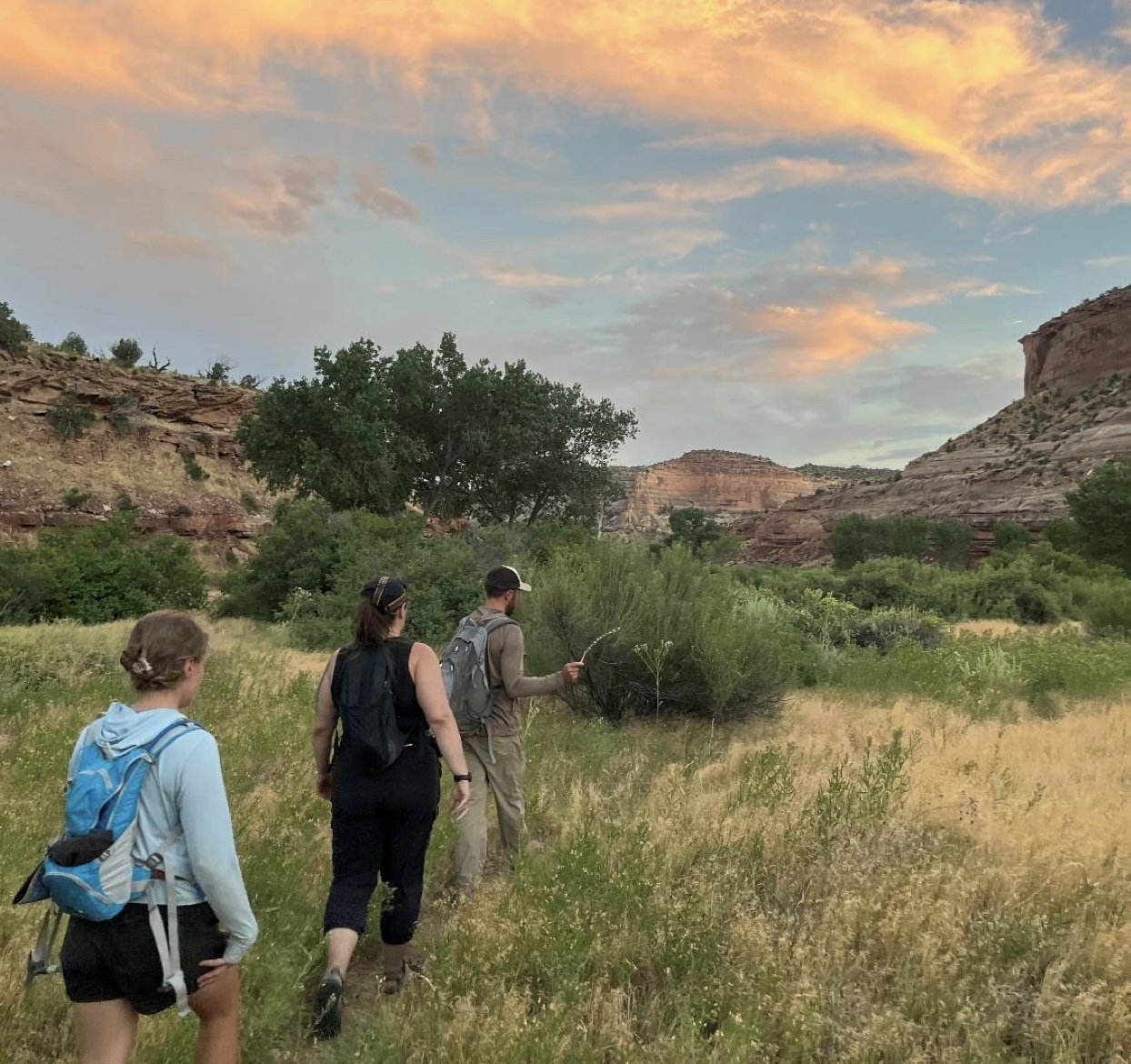
The Black Ridge Canyons Wilderness (BRCW) spans roughly 75,000 acres of deeply incised canyons in western Colorado and eastern Utah. Its rugged terrain shelters ephemeral riparian pools, or small, temporary water bodies, that support native amphibians such as canyon treefrogs, Woodhouse’s toads, and red-spotted toads. These pools are biological lifelines for these creatures in an otherwise arid landscape.
Climate change is rapidly altering the conditions that sustain these ecosystems. Rising temperatures, shifting precipitation patterns, longer droughts, and increasing wildfire risk are shortening hydroperiods and degrading riparian habitat. At the same time, invasive species such as tamarisk, cheatgrass, and American bullfrogs are expanding their foothold, compounding stress on native flora and fauna.
For managers, the dilemma is acute: Should they intervene to preserve historical conditions, allow ecosystems to change on their own, or actively guide transformation toward new, desired states? In wilderness, where the mandate is to remain untrammeled by humans, each option carries ecological, legal, and ethical trade‑offs.
Rangwala played a key role in grounding the project’s ecological discussions in robust climate projections. He states, “The project introduced a unique way of thinking about wilderness, including using scenarios and visuals to explore futures in a way that was new to me.” Using the Climate Toolbox’s Future Climate Scenarios tool, the team examined mid‑century climate futures under multiple projections. Three plausible scenarios were considered for the Black Ridge region: warmer and wetter, hot, and hotter and drier.
While precipitation outcomes differed across scenarios, one signal was consistent: under any scenario, the Black Ridge Canyons wilderness will experience increasing temperature-driven water stress. Rising heat, vapor pressure deficit, and climatic water deficit point toward continued drying, even in scenarios where total precipitation increases. These findings underscore a critical insight for managers: future ecological change may be driven more by heat and evaporation than by rainfall alone.
In consultation with ecologist Kyra Clark-Wolf, the team translated climate projections into tangible ecological futures. Through expert workshops, scientists and managers explored how amphibian populations, riparian vegetation, wildfire regimes, and invasive species might respond across landscape and site scales.
Across all climate scenarios, several transformation themes emerged: (1) loss of deep, long‑lasting pools critical for amphibian breeding; (2) conversion of native riparian vegetation to upland or invasive species; (3) increased sedimentation from wildfire and intense storms; and (4) heightened competition and predation from invasive bullfrogs.These shifts threaten not only individual species, but also the broader ecological character and cultural value of wilderness landscapes.
The climate and ecological scenarios informed by NC CASC scientists were critical to guide a two‑day, in‑person workshop that brought together BLM staff, partner agencies, and researchers. Using the RAD framework, participants explicitly generated and evaluated management options across three categories:
- Resist: Actions to maintain historical conditions, such as removing bullfrogs, restoring riparian vegetation, or supplementing water in drying pools.
- Accept: Choosing not to intervene, while investing in monitoring and learning as ecosystems change.
- Direct: Actively shaping new futures, including assisted migration or creating habitat outside wilderness boundaries.
Importantly, the process did not prescribe a single “right” answer. Instead, it emphasized intentionality, transparency, and defensibility, which are essential qualities when managing highly scrutinized public lands. While rooted in Black Ridge Canyons Wilderness, the implications of this work extend far beyond a single landscape. As climate change pushes ecosystems past historical baselines, RAD offers a repeatable, adaptable framework for wilderness managers nationwide. In an era when change is unavoidable, this project reframes stewardship not as preventing transformation at all costs but as choosing, together, how to live with it.