

Author
Tackling Woody Encroachment Across the Great Plains
Date
Across the Great Plains, the spread of trees and shrubs into historically open grasslands is changing landscapes and creating new challenges for conservation. Known as woody encroachment, this expansion can alter wildlife habitat, forage, water availability, fire behavior, and other ecological processes. For land managers, addressing the problem requires more than removing trees and shrubs. They also need to determine where and when to act, which approaches are most effective, and how to measure whether management is succeeding. These are questions that are becoming increasingly important as climate conditions change.
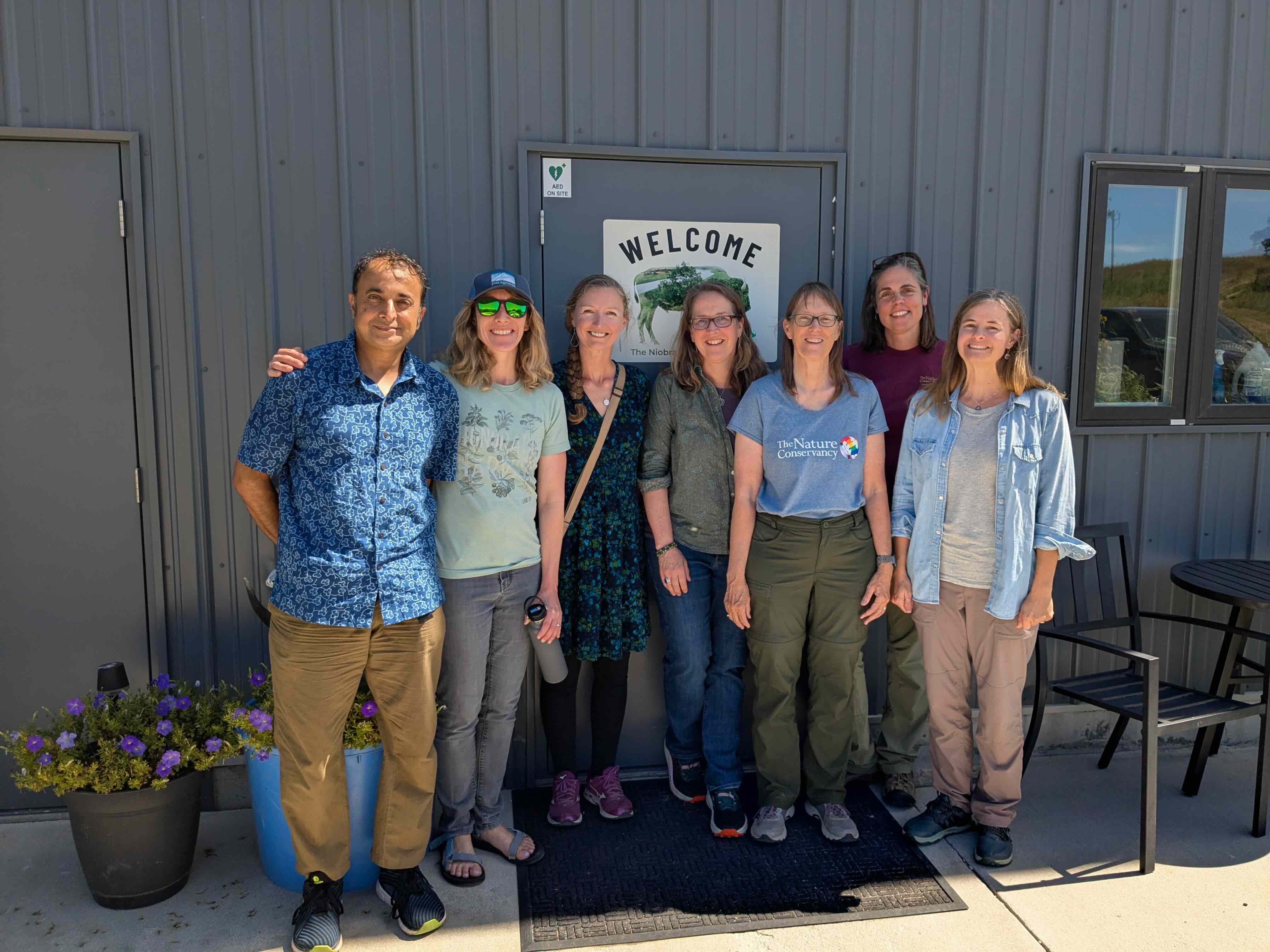
On September 2 - 3, 2026, NC CASC researchers joined land managers, scientists, and conservation partners from across the Great Plains for a workshop at The Nature Conservancy’s Niobrara Valley Preserve in Nebraska. Organized by The Nature Conservancy’s Marissa Ahlering and Terri Schulz, the two-day gathering brought together participants from The Nature Conservancy, NC CASC, USGS, state agencies and universities, with perspectives spanning Texas to North Dakota. The workshop focused on improving how conservation practitioners evaluate and respond to woody encroachment across Great Plains grasslands. Participants explored management objectives for woody vegetation, climate adaptation, land management techniques, and the indicators, metrics, and monitoring approaches that can help managers determine whether treatments are achieving their intended outcomes. NC CASC/USGS researcher Meagan Oldfather contributed to these discussions with presentations on assessing treatment effectiveness and analyzing management outcomes, including how satellite remote-sensing data can be used to track woody encroachment before and after treatment.
“Woody encroachment is a challenge across the Great Plains, but the goals, conditions, and management needs can look very different from one place to another,” said Marissa Ahlering, Director of Science for The Nature Conservancy in Minnesota, North Dakota, and South Dakota. “By bringing practitioners and scientists together from across the region, we can learn from those different experiences and work toward approaches that help managers make more informed decisions and evaluate whether their actions are having the intended effect.”
Despite differences among grassland systems and the species managers are confronting, many of the same challenges emerged across the region. Participants identified similar priorities for evaluating management effectiveness and expressed strong interest in finding better ways to use technologies such as remote sensing to monitor changes and assess outcomes over larger areas. The workshop is intended to be the beginning of a longer-term effort to develop meaningful, practical metrics for evaluating woody encroachment management under changing environmental conditions.
For NC CASC lead climate scientist, Imtiaz Rangwala, one of the most valuable parts of the workshop was getting outside the meeting room and seeing management in action. Participants visited treated sites across the Niobrara Valley Preserve, where eastern red cedar, sumac, and other woody vegetation are particular management concerns. “Seeing management outcomes firsthand - and having conversations in the field about what worked, what didn’t, and why - provided a much more comprehensive understanding of the challenges than discussions in the meeting room alone,” Rangwala said. Those conversations brought together managers’ practical experience, the unique characteristics of individual sites, and broader questions about how scientists and practitioners define and measure successful management. They also gave Rangwala a deeper appreciation for how difficult it can be to translate a management plan into action. Managers must contend with limitations in staffing, equipment, time, and other resources while remaining flexible enough to act when environmental conditions are favorable. Climate can complicate those decisions even further. One of the key insights to emerge from the workshop was that changing climate conditions affect not only grassland ecosystems, but managers’ ability to carry out treatments in the first place.
Prescribed fire provides a particularly clear example. Fire is an important tool for managing grasslands and controlling woody vegetation, but determining when to conduct a burn is far more complicated than simply looking for a day without rain. Weather, fuels, site conditions, management objectives, available personnel and equipment, and operational constraints all interact to determine whether a burn can safely and effectively proceed. “The concept of a ‘good burn day’ is much more nuanced than I had appreciated,” Rangwala said. That realization could also point toward a future role for NC CASC science. Rangwala sees an opportunity to work with TNC land managers to combine their ground-based observations and management knowledge with climate and weather information. Together, those perspectives could help more objectively characterize favorable burn windows, potentially supporting tools that help managers anticipate suitable conditions in the near term.
The same approach could also be used to look farther ahead: How might the number, timing, or characteristics of suitable burn days change under future climate conditions? And what would those changes mean for managers trying to keep woody vegetation from expanding across grasslands? Questions like these illustrate why working directly with practitioners is central to actionable climate adaptation science. Useful information must reflect not only how ecosystems are changing, but the decisions managers actually face and the conditions under which they can act.
The Niobrara workshop highlighted the benefits of giving managers from different parts of the Great Plains dedicated time to compare experiences. Although participants came from different states and worked in different ecological systems, many found themselves confronting similar questions about treatment effectiveness, monitoring, capacity, and climate. Bringing those perspectives together can help identify where common approaches or tools could be useful across the region while still accounting for local ecological and management differences.
The discussions at the workshop kept visiting a broader challenge: in some places, woody expansion has become widespread and persistent enough that returning a landscape to a historical condition may be increasingly difficult. As climate conditions continue to change, managers may need to think beyond individual treatments and consider larger questions about what future conditions are both desirable and achievable. That includes deciding where continued resistance to woody encroachment remains realistic, where restoration is still possible, and where management may instead need to guide an already transforming ecosystem toward a different but valued condition. These conversations also highlighted the importance of discussing the social acceptance of ecological change and the goals communities, landowners, and agencies are willing to pursue as landscapes continue to change.
The visit also surfaced potential connections beyond woody encroachment. The Niobrara Valley Preserve manages a herd of roughly 1,500 bison as part of its landscape-scale conservation work. Rangwala identified an opportunity to connect TNC’s experience managing bison at the preserve with an NC CASC Working Group Science Synthesis effort focused on bison restoration, potentially providing additional lessons about integrating bison into grassland conservation and management.
More broadly, the workshop demonstrated how field-based collaboration can help bridge the gap between science and practice. The Nature Conservancy manages its own preserves while also working with neighboring landowners and communities to support ecosystem health, biodiversity, ranching, recreation, and other priorities. NC CASC can bring climate science, synthesis, and decision-support expertise to those conversations. As woody vegetation continues to transform parts of the Great Plains, managers will need ways to understand not only where landscapes are changing, but whether their efforts to respond are working. Developing those answers together and combining climate science and emerging technologies with the experience of the people managing these landscapes every day can help build more effective and climate-informed approaches to conserving the Great Plains.