


Author
Adapting to Changing Snowpack: Implications for Water in the Western United States
Date
Winter in Colorado this year offered a compelling reminder that climate change is already reshaping hydrologic patterns across the western United States. Snowpack, long relied upon as the region’s natural reservoir, is becoming less predictable. In many places, it is arriving later, melting earlier, and in some cases, failing to accumulate at all. What once followed a relatively stable seasonal cycle is now shifting, with consequences that ripple through water supply, ecosystems, agriculture and wildfire dynamics.
Recent reporting by the North Central Climate Adaptation Science Center’s (NC CASC) climate scientist Imtiaz Rangwala underscores a broader trend across the West, reflected in this year’s unusually low snowpack. Warmer winter temperatures are increasingly pushing precipitation to fall as rain instead of snow, particularly at mid-elevations. Even when snow does accumulate, it often melts earlier in the spring, shifting the timing of runoff. This means less water is stored for the dry summer months, when demand is highest. Scientists describe this phenomenon as a “snow drought”, a condition where total precipitation may not be dramatically lower, but the form and timing of that precipitation fundamentally alters water availability.
Low snowpack years like this one offer a glimpse into the future, but they also raise an important question: how do we plan for a system that is no longer behaving the way it used to? For many resource managers, the challenge is not a lack of climate information. In fact, there is an abundance of climate projections available, ranging from global climate models to highly detailed, downscaled datasets. The real challenge lies in determining which information is most relevant, how to interpret it and how to apply it to real-world decisions. Different models may produce different outcomes. Different emissions scenarios lead to different futures. And different decisions require different types of information.
This is where the Practical Considerations for Climate Data Selection resource, currently hosted on the NC CASC’s Climate Adaptation Science Support page and accompanied by a recent webinar, becomes especially valuable. Rather than treating climate projections as a single answer or prediction, this guidance reframes them as tools to support decision-making. It provides a structured, step-by-step approach for scientists and resource managers to work together. Climate projections come in ensembles, meaning multiple models are used to represent a range of possible futures. Rather than choosing a single “best” model, the guidance encourages using multiple models to capture uncertainty and variability. This allows decision-makers to explore a range of plausible outcomes, rather than relying on a single prediction that may or may not materialize.
Importantly, the guidance also addresses uncertainty as an inherent and informative part of climate science. Uncertainty arises from multiple sources, including natural variability, model differences and future emissions pathways. Instead of avoiding uncertainty, our guidance encourages users to explicitly consider it in their planning. For example, decisions can be stress-tested against a range of scenarios to evaluate how robust they are under different conditions. This approach is especially relevant in the context of changing snowpack. As this winter has shown, variability is increasing and extremes are becoming more consequential. Planning based solely on historical averages is no longer sufficient. Instead, managers need to consider a wider range of conditions, including low-probability but high-impact scenarios. While this year’s conditions may feel extreme, climate models suggest that such conditions could become more common in the coming decades. By integrating projections with observed data, we can better anticipate not just what is happening now, but what is likely to happen in the future.
In summary, climate adaptation is about making informed decisions in the face of change. It requires bridging the gap between complex scientific data and practical, on-the-ground action. Resources like the NC CASC’s guidance help make that bridge possible by translating climate projections into a format that is relevant and actionable. The story of this winter’s snowpack highlights the urgency of adapting to a changing climate, but also the growing capacity of scientists and decision-makers to work together to address that challenge.
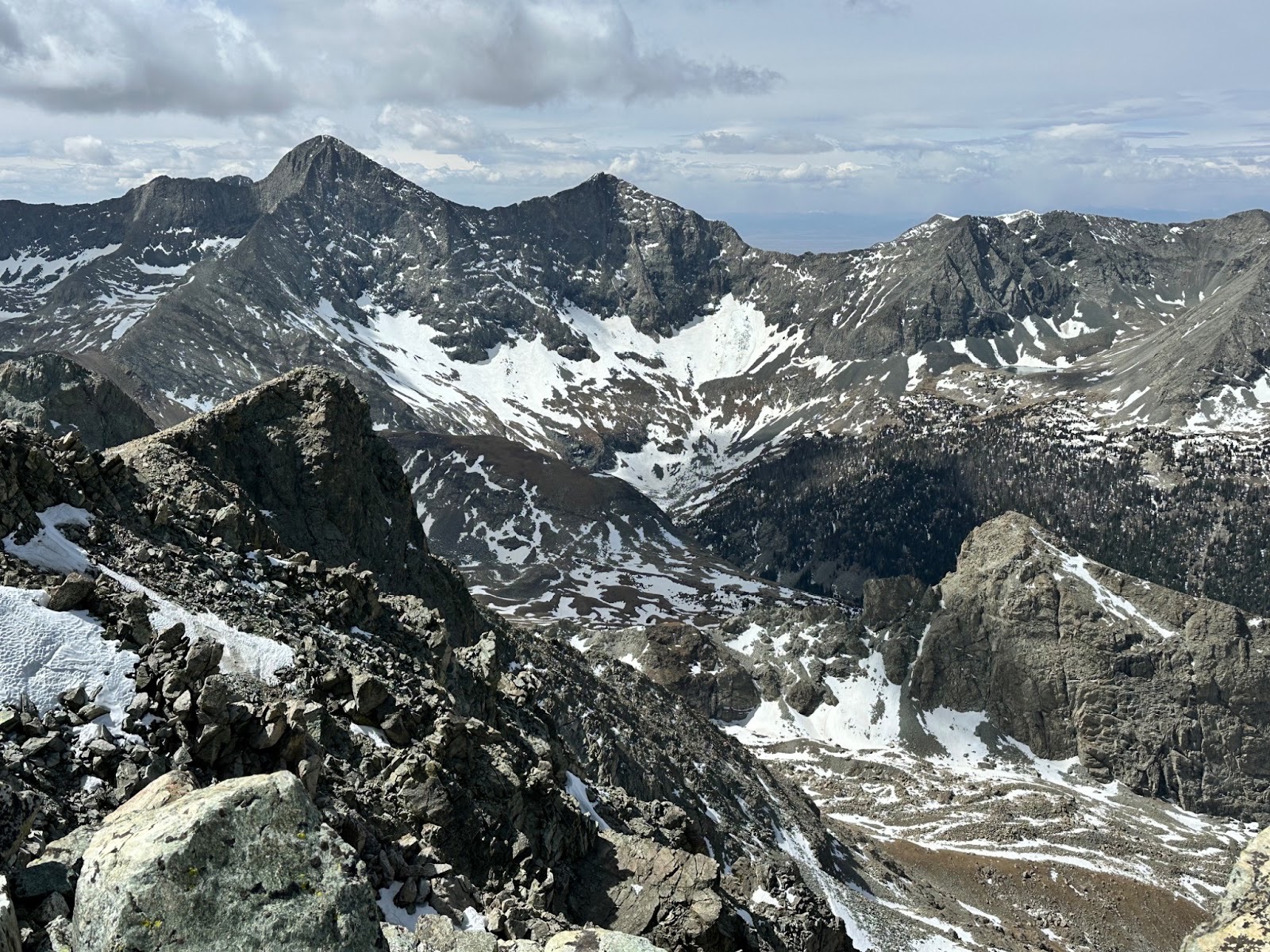
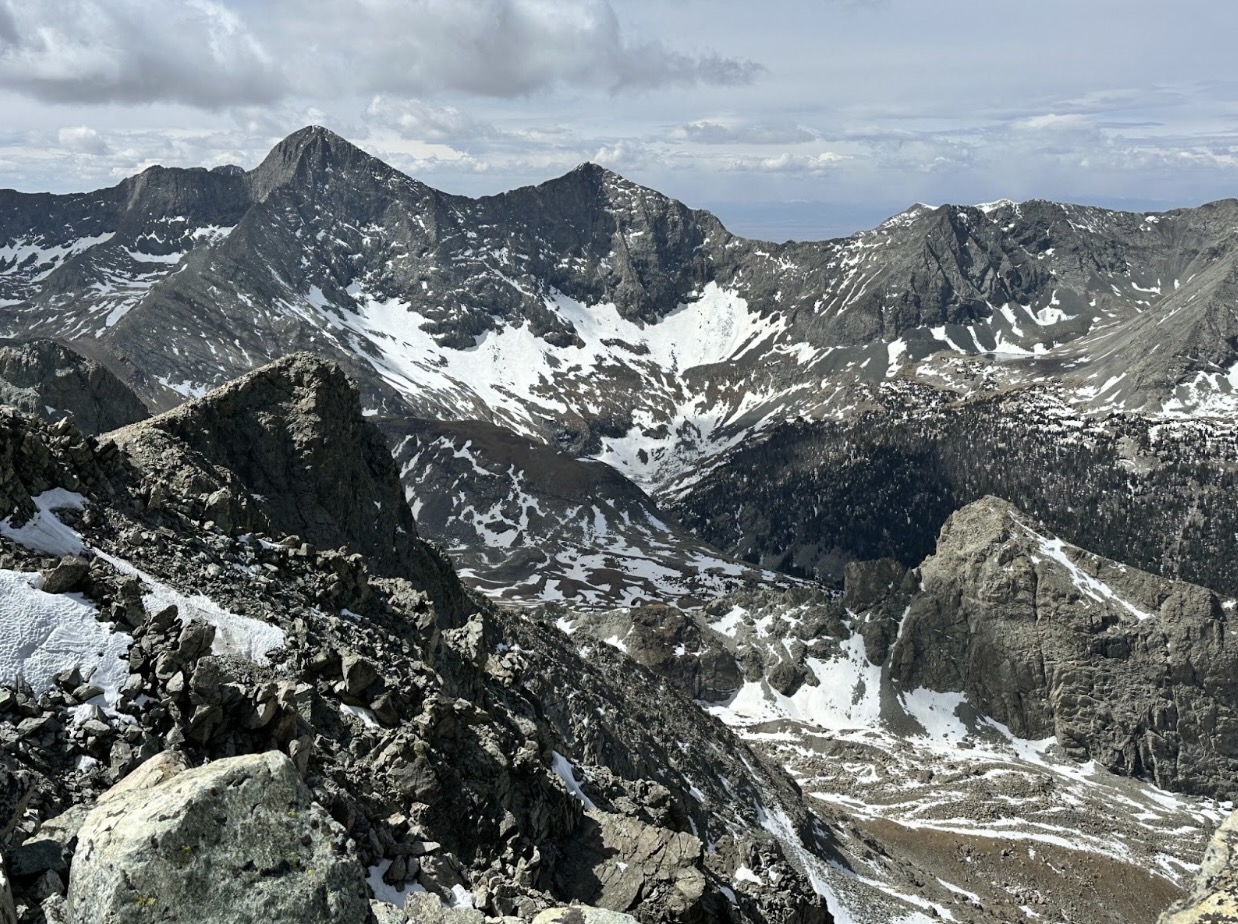
Snow conditions in the Sangre de Cristo Mountains, Colorado. For this time of year, there should be a much more robust snowpack, yet it looks like a summer snowpack. Photo by Ulyana H. Pena, from the summit of Huerfano Peak (13,837 feet).